Musk v. Altman live updates: Sam Altman testifies in trial that could determine OpenAI's future

ByABC7 Bay Area Digital Staff and Frances Wang KGO logo
Last updated: Tuesday, May 12, 2026 9:50PM GMT
Musk v. Altman: Microsoft CEO and OpenAI Co-founder take the stand

OAKLAND, Calif. (KGO) -- Technology tycoons Elon Musk and Sam Altman are facing off in a high-stakes trial revolving around the alleged betrayal, deceit and unbridled ambition that blurred the bickering billionaires' once-shared vision for the development of artificial intelligence.

The trial centers on the 2015 birth of ChatGPT maker OpenAI as a nonprofit startup primarily funded by Musk before evolving into a capitalistic venture now valued at $852 billion.

The civil lawsuit accuses Altman, OpenAI's CEO, of double-crossing Musk by straying from the company's founding mission to be an altruistic steward of the technology.

CNNWire logo
May 12, 2026, 9:50 PM GMT

'Are you completely trustworthy?': Musk's attorney presses OpenAI CEO in trial

Elon Musk's lawyer began his cross examination of OpenAI CEO Sam Altman in court on Tuesday with a brief question: "Are you completely trustworthy?"

Musk is suing the company and its leaders over allegations that OpenAI, Altman and president Greg Brockman breached their charitable trust when OpenAI shifted from its nonprofit mission to include a profit-oriented structure. Microsoft, an early investor in OpenAI, is named as a co-defendant.

Musk's lawyer grilled Altman about accusations of dishonesty from OpenAI's board members, his investments and his brief, tumultuous ousting as CEO in 2023.

In contrast, OpenAI's attorney suggested Musk, who helped create and fund the company, angled early for total control of OpenAI as Altman pushed back to ensure the powerful tech was not dominated by just one person.

Musk wants the judge to order OpenAI to revert to a nonprofit and for Altman and Brockman to lose their board positions. He's also asking that more than $130 billion go back into OpenAI's nonprofit arm. A ruling in Musk's favor could scramble OpenAI's plans for an initial public offering later this year.

OpenAI has denied Musk's claims, saying Musk wanted a for-profit structure and only brought the case after he failed to gain control of OpenAI. OpenAI has claimed Musk, who started his own AI company after leaving OpenAI in 2018, is now attempting to harm a competitor.

Altman's trustworthiness questioned

Musk attorney Steven Molo cited earlier testimony from OpenAI board members and former executives that Altman was dishonest and created a toxic culture of lying.

Altman called himself "an honest and trustworthy business person" but said he wasn't aware of some specific accusations.

Altman also criticized how the board handled his removal and said there were "misunderstandings."

"I was not trying to deceive the board," he said.

OpenAI board members and executives testified about their qualms with Altman earlier in the trial, including what they described as his resistance to the board's oversight and alleged dishonesty with senior leadership, including former Chief Technology Officer Mira Murati.

OpenAI cofounder Ilya Sutskever, who played a major role in Altman's displacement, testified on Monday that he spent months gathering evidence showing what he said was Altman's pattern of deception and poor management. Sutskever later voted to have Altman return, saying he regretted the decision. Altman returned to his role just days after his removal and a new board was instated.

Altman described the 2023 events as an "incredible betrayal" that was "very public" and "very painful" in Tuesday's testimony.

"If I knew how difficult and painful this was going to be, I never would have tried," Altman said of his decade at OpenAI. "I'm very grateful I didn't, because other than my family, this has been the most meaningful thing in my life I could imagine."

Control over the future of AI

Control over artificial general intelligence, a hypothetical stage of AI in which its cognitive abilities match that of a human across any subject, was an important factor in OpenAI's founding, Altman said. The company was founded in part because Altman and the other cofounders believed one person should not be in charge of AGI if it were achieved, he said.

Musk wanted "total control" of any for-profit OpenAI entity to start, Altman testified, with a promise to reduce that control over time. But Altman wasn't convinced Musk would step back, citing his experience working with startups where leaders rarely give up power over a successful company, he said.

"My belief is he wanted to have long-term control and that he would have had that had we agreed to the structure he wanted," Altman said.

OpenAI's cofounders once asked Musk an important question: If he were to control OpenAI, what would happen to the company on his death? Musk responded that he hadn't thought about it much and that he might pass it on to his children.

Musk's reply was a "hair-raising moment" in the early days of OpenAI, Altman said.

"I didn't feel comfortable with that," Altman said

Musk eventually resigned because he lost confidence in OpenAI and didn't think it would be successful, Altman suggested. At one point, Musk wrote in an email that OpenAI wasn't a "serious counterweight" to Google's DeepMind AI research lab, according to evidence presented in court.

Google was considered the AI leader around the time OpenAI was established. Altman almost didn't even start OpenAI because he thought the search giant was so far ahead, he said.

Before resigning from OpenAI's board in 2018, Musk "demotivated" some key researchers by ranking their accomplishments, Altman testified, which damaged the company culture. Musk's resignation boosted morale, Altman added.

This story has been updated with additional information.

The-CNN-Wire
& 2026 Cable News Network, Inc., a Warner Bros. Discovery Company. All rights reserved.
CNNWire logo
May 12, 2026, 4:31 PM GMT

Sam Altman takes the stand in trial that could determine OpenAI's future

Sam Altman almost didn't even start OpenAI, now considered a leader in AI, because he thought Google was so far ahead in artificial intelligence that doing so would be hopeless.

That was one of the revelations the OpenAI CEO made on Tuesday when he took the stand in a trial that could determine the future of his company and potentially the AI industry.

Elon Musk, who cofounded and helped fund OpenAI, is suing the company and its leaders over allegations that OpenAI, Altman and president Greg Brockman breached their charitable trust when OpenAI shifted from its nonprofit mission to include a profit-oriented structure. Microsoft, an early investor in OpenAI, is named as a co-defendant.

Musk wants the judge to order OpenAI to revert to a nonprofit and for Altman and Brockman to lose their board positions. He's also asking that more than $130 billion to go back into OpenAI's nonprofit arm. A ruling in Musk's favor could scramble OpenAI's plans for an initial public offering later this year.

OpenAI has denied Musk's claims, saying Musk wanted a for-profit structure and only brought the case after he failed to gain control of OpenAI. OpenAI has claimed Musk, who started his own AI company after leaving OpenAI in 2018, is now attempting to harm a competitor.

Musk's attorneys have tried to paint Altman as deceptive and have brought up his brief ousting in 2023, when the company's board temporarily pushed him out as CEO over concerns about his leadership.

OpenAI board members and executives testified about their qualms with Altman, including his resistance to the board's oversight and alleged dishonesty with senior leadership, including former Chief Technology Officer Mira Murati.

OpenAI cofounder Ilya Sutskever, who played a major role in Altman's removal, testified on Monday that he spent months gathering evidence showing what he said was Altman's pattern of deception and poor management. Sutskever later voted to have Altman return, saying he regretted the decision. Altman returned to his role just days after his removal and a new board was instated.

Altman's own words have also been used as evidence. "I remain enthusiastic about the non profit structure!" he wrote in a 2017 email to Musk during discussions about OpenAI's structure, including the development of a for-profit entity.

When reports surfaced in 2022 indicating Microsoft was considering further investment into OpenAI, already valued at $20 billion at the time, Musk texted Altman that he felt like the situation was "a bait and switch" after saying he "provided almost all the funding."

"I agree this feels bad," Altman responded, adding that OpenAI had offered Musk equity in its capped for-profit entity which Musk declined at the time.

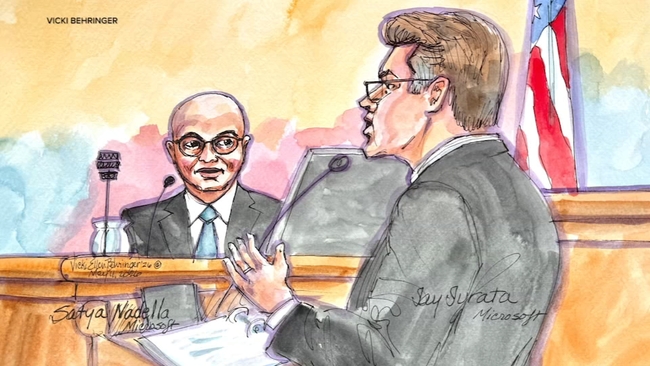
Microsoft's relationship with OpenAI, its motivation for investing in the company and its access to OpenAI's technology and intellectual property were a major focus during CEO Satya Nadella's testimony on Monday.

Altman's testimony is expected to continue into Wednesday, with closing arguments beginning on Thursday before jury deliberations.

ByFrances Wang KGO logo
4:31 AM GMT

Microsoft CEO and OpenAI Co-founder who both helped oust Sam Altman take the stand

Testimony from Microsoft CEO Satya Nadella and OpenAI co-founder Ilya Sutskever highlighted competing narratives Monday in the legal battle between Elon Musk and OpenAI, as jurors heard from key witnesses in federal court.

Testimony from Microsoft CEO Satya Nadella and OpenAI co-founder Ilya Sutskever highlighted competing narratives Monday in the legal battle between Elon Musk and OpenAI, as jurors heard from key witnesses in federal court.

Musk is suing Microsoft for aiding and abetting in a breach of charitable trust, as part of a broader case centered on OpenAI's structure and mission. Nadella took the stand early Monday morning, having been seen pacing in the hallways before his testimony.

"From the OpenAI perspective, the testimony of Mr. Nadella was compelling, candid, straightforward and told the story, which is that Microsoft was a partner," said William Savitt, an attorney for OpenAI.

Nadella described Microsoft's early investment in OpenAI as a significant risk and framed the relationship as a partnership that helped the company grow. He testified that Musk never raised concerns directly with him, saying, "We have each other's phone numbers."

The Microsoft CEO also addressed the brief removal and reinstatement of OpenAI CEO Sam Altman in 2023, a pivotal moment referenced frequently during the trial.

"After Sam Altman was fired and reinstated Nadella, Nadella was in close communication with Mr. Altman and with others at OpenAI, and it was instrumental in his reinstatement and in choosing a new board for the nonprofit," said Marc Toberoff, an attorney for Musk.

Nadella denied demanding Altman's reinstatement, instead characterizing Microsoft's role as an effort to stabilize OpenAI.

He testified that the company sought clarity from the board while also preparing contingency plans to hire Altman and other OpenAI staff if necessary.

Jurors also heard from Ilya Sutskever, OpenAI's co-founder and former chief scientist, who offered insight into the company's early days and internal dynamics.

Sutskever testified that Musk pushed him outside his comfort zone but said there was never a promise that OpenAI would remain a nonprofit organization.

"What you heard him say is that there were never any promises made that could form the charitable trust that Mr. Musk says existed," Savitt said.

Sutskever also addressed his role in Altman's temporary ouster, describing it as an urgent move driven by concerns about leadership.

"I simply care," said Sutskever on the witness stand. "I didn't want it to be destroyed," as he explained his decision and concerns that Altman's behavior was not conducive to maintaining a safe environment for artificial intelligence development.

He testified that he had concerns about Altman's leadership for about a year before the decision and described the situation as a "Hail Mary."

Sutskever's testimony also underscored his long-standing belief in OpenAI's mission. He said he once declined a $6 million annual salary at Google to join OpenAI and estimated his current stake in the company at about $7 billion.

The case has drawn a sharp contrast between Musk's argument, summarized in court as "It's not OK to steal a charity," and Sutskever's one-liner today: "The mission of OpenAI is larger than the structure." With testimony from Nadella and Sutskever complete, jurors are now hearing from Bret Taylor, chairman of the board of directors, as well as chairman of the OpenAI Foundation, which is the non-profit governing the for-profit subsidiary.

Up next: Sam Altman, who is anticipated to take the stand as early as Tuesday.

The trial is progressing toward closing arguments, with jurors expected to begin deliberations by Thursday.

KGO logo
May 11, 2026, 2:08 PM GMT

Microsoft CEO to testify as week 3 of trial begins

Microsoft's CEO Satya Nadella is reportedly set to testify Monday in the landmark battle over artificial intelligence in Oakland.

Monday marks the start of week three of testimony.

OpenAI CEO Sam Altman is also expected to take the stand this week, as defense attorneys lay their case.

Elon Musk is suing OpenAI, accusing the company of abandoning a promise to remain a non-profit. The promise was allegedly tied to Musk's investment in the company.

Altman has accused Musk of trying to hobble the ChatGPT maker for the benefit of his own AI company.